Should I have written this book?

After reading accounts of what the subprime crisis had meant to ordinary people, I was tempted, or perhaps even inspired to write a story about it.

I imagined someone who’d been abroad on military service, with little knowledge of what was actually happening in his home country (the USA), coming home and discovering what had happened to his family and friends, and taking revenge. Since the subprime crisis largely affected people of colour, I decided that the protagonist should be African-American and the family should come from suburban Ohio. [note: although the book is written using US spellings such as ‘color‘, this article uses UK spellings; ‘colour‘.]

For an opposite number, out to stop the revenge killings, I chose a financial journalist working in New York City. And they would be female and gay.

Now, I had saddled myself with a lot of what is often terms “cultural appropriation” there:

  • I am not American – I have never even lived in America for more than a couple of weeks at a time
  • I am not a person of colour
  • I have never served in the USMC, or any branch of any military, other than as an RAF cadet at school
  • I’ve never been to Ohio
  • I’ve only been in NYC for an afternoon
  • I am not female
  • I am not gay
  • And though I do have experience of working with large news organisations, I’ve never been employed by one

But even so, I wanted to write this book. I do have friends, both in the USA and also from the USA living in Japan, whose brains I could pick, and use to check dialogue and general flavour (and American spellings). One of those who provided the most assistance was Bev Thomas, a Facebook friend, who also wrote a short guide to assist those who are in danger of losing their homes, which I included in the book as an appendix.

STOP PRESS!

I’ve just dropped the price of the ebook to $0.99 or local equivalent worldwide. Get it from Amazon, or other booksellers.

Balance of Powers features an African-American Afghan vet, Major Henry Powers, USMC, who comes home to find his sister’s house repossessed by the bank which sold her the mortgage, and his sister and her children out on the streets – somewhere. While searching for them, he meets Jeanine and her children, who have likewise been made homeless. What he finds sends him into a killing rage, and bodies pile up in his wake as he discovers the corruption and sleaze that surrounds the whole business, from mortgage salesmen up to traders in international financial houses.

Meanwhile in New York, Kendra Hampton, financial journalist, finds out more about the Wall Street murders that have spooked the trading floors. She finds herself on a collision course with Powers, which ends dramatically in New York City.

Now all of this is quite a feat of imagination, when you’re writing from Japan. I was somewhat nervous when I first put it out with an American publisher, but judging from the reviews, no one seems to have noticed my British accent.

The book also includes some relatively explicit sex scenes and sexual references, a lot of four-letter words, and quite a lot of violence – way out of my usual comfort zone. Against which, I think I produced at least three well-rounded characters:

  • Major Henry Gillette Powers: ex-USMC Afghan vet. An intelligent compassionate man moved to acts of extreme violence by what he sees around him.
  • Jeanine (other name unknown): mother of three children, now single, and made homeless through the repossession of her house.
  • Kendra Hampton: financial journalist living and working in NYC. Partner with Liz.

And some dialogue that I enjoyed writing:

“Hey! Where are you going? Downtown’s the other way.”
“I know. I’ve been thinking.”
“Uh-oh. Every time a man says that, it means he’s thinking of dumping you.”
“Not exactly, but…”
“And that’s another one that means the same thing. Been nice knowing you, Henry. Stop the car now, so’s I can get out? Pop the trunk, let me get my things? Okay?”
“It’s not that.”

Balance of Powers: Ch 11

And also some writing of interactions that I feel pleased with:

He was more than a little intimidating – a tall, well-built black man in a beautifully-cut suit and a military air about him. He introduced himself only as “Henry”, without a last name. She noticed a Marine Corps ring on one hand, but refrained from asking any questions about it.
“Did you know Mr. Reichman?” she asked him.
“Yes, ma’am, I did.” Very cool and correct, not giving away more than he had to.
There was something vaguely familiar about his face. “Have we met?”
“I’m sure I would remember you, ma’am.” A smile which ickered briey and then vanished as if it had never been.
“Strange,” she mused. “Pardon my curiosity, but may I ask how you met Mr. Reichman?”
“We met at a social event.” This guy wasn’t going to give anything away. Something told her that uttering her eyelashes at him and using her feminine charms was going to have as much effect on him as it would do on the coffee machine in the corner.

Balance of Powers Ch 22

So all in all, it’s a book I’m pleased with. It has good characters, a decent plot, a message that doesn’t beat you over the head, and a style that perhaps disguises the origin of its author.

Was it really 14 years ago?

airport bank board business

I’m referring to the large financial disaster, which brought about the demise of some of the largest financial institutions in the world, and affected the lives of many. At the time I was living in Japan, where the crisis caused by the securitisation of bad loans was known as “The Lehman Shock”, Lehman Brothers being one of the most prominent casualties of this seismic event.

I was working on the fringes of the financial world, having worked in two major non-Japanese financial institutions, and working for a Japanese bank at the time, but I was minimally affected, though I lost out on a contract to pre-edit Bear Stearns’ investor prospectus prior to the issue of a Japanese version.

However, several of my friends within the financial services industry were affected, and I came to learn of the hardship caused by the dishonest practices of the lenders who took advantage of their clients to earn a fast buck. Michael Lewis’s The Big Short is an excellent introduction to all this (the movie, not so much, in my opinion). In any event, it spurred me into writing two books. Here’s something about the first one.

At the Sharpe End

This was my lecture at the Foreign Correspondents Club of Japan, of which I subsequently became a member, where I introduced the book to a number of people, both Japanese and foreign residents of Japan. It’s quite long, but I think it’s worth watching.

I started to write this some time before the 2008 crash. It was based loosely around what I knew of the financial industry from my own experience, and the experiences of my friends.

It concerns a freelance consultant living in Tokyo (I always say that the protagonist, Kenneth Sharpe, is not me, but I could not have created him without my experiences) who finds himself in possession of a secret technology that allows him to make money in large quantities (technologies very similar to this technology actually exist now – fiction prefiguring fact).

(You can find the book for sale here)

Anyway, for the plot to be interesting, the hero can’t just waltz off into the sunset with his pockets bulging with cash – there must be something to hold the reader’s interest. In this case, I really wanted an external catastrophe that prevented the technology from doing its thing, and so guess what I chose? I was living in Japan, a country with frequent earthquakes and a reliance on nuclear power for much of its energy needs.

March 11, 2011

Yes, I chose an earthquake which wrecked a nuclear power station. This was in 2007/early 2008, several years before the Fukushima disaster. I don’t claim enormous credit for predicting this. I’m not a prophet. The Hamaoka power station, which was the one I described as being wrecked, is situated on the junction of three fault lines. In my opinion, a bloody stupid place to build a fault line. I also did not take account of tsunami action. Incidentally, I was convinced at one point that my wife and I, along with thousands more, were going to die from radiation poisoning. We were lucky that was not the case, though I probably have absorbed more radiation than if I had been living in the UK at the time.

However, after writing this section, along came the Lehman Shock, which made my earthquake rather redundant. I therefore had to change the story a bit, and also, given the time of the year, had to change some of the details in the story to reflect this (heaters went off, air-conditioners went on, etc.). I also incorporated some of the conversations that I’d had with my financial friends in the Foreign Correspondents’ Club of Japan, where I launched the book (always nice to talk about your book in the places featured in the book – happened to me twice now).

The first edition didn’t incorporate the quake, but used the Lehman shock but when I republished with Inknbeans Press in 2012 (post-Fukushima), I added the parts that I had originally written, and the current editions also have .

Anyway, a lot of readers have found it to be a very convincing and authentic look at life in Japan for non-Japanese, as well as being a well-written thriller with lots of twists and turns, and some interesting characters.

Next, I’ll be writing about my other book that came out of the subprime crisis – Balance of Powers.

Jack and the Beans

green vegetable on white surface

Our local writers’ group gave as an exercise a re-placement of a fairy-tale character in a novel situation. However, I decided to be a little different (surprise, surprise) and ended up writing a slightly surreal piece of nonsense loosely based on what I could remember of Jack and the Beanstalk.


Once upon a time, there was a boy named Jack who lived with his mother in a small cottage hallway between the towns of Nowhere and Nothing. They were so poor that they used to beg for crumbs from the church mice who sometimes came to visit, but their sole possession, other than a 42” plasma TV, was a cow called Eric. The television had never worked, chiefly because there was no electricity in the cottage, but it was very useful for stopping the draft from the broken window.

“Why is our cow called Eric, Mother?” Jack would ask on long winter evenings. Sometimes he asked the same question on short summer evenings, but not so often, because the evenings were shorter.

He always forgot the answer that his mother gave him, and his mother always forgot that he had asked the same question twenty times already that month. So they were both perfectly happy with that evening’s entertainment.

“Who needs Netflix,” they would ask each other, “when you have a cow called Eric?”

But neither of them knew the answer to that question.

There came a time when even the church mice stopped coming, pleading pressure of work, and a disturbing trend in atheism.

“We must sell Eric,” said Jack’s mother. “You must go to the market in Nowhere and sell her, so that we can eat.”

So, one day, Jack set off for the market of Nowhere, leading Eric on a piece of string. His mother waved farewell to them with her last clean paper tissue, which she had been saving for Sunday best, but she had brought it out in honour of the occasion.

In six hours, Eric returned, leading Jack on the same piece of string.

Jack’s mother was about to ask Eric what had happened, when she stopped, realising that she had forgotten to put her false teeth in, and that Eric wouldn’t be able to understand her. She turned to Jack.

“I’m sorry, mother,” said Jack. “I tried to sell Eric so that we could feed ourselves, but no one wanted to give me anything to eat. All they wanted to give me in exchange was money. And you can’t eat it. I tried, and it tasted horrible.”

“Oh, you silly boy! Trying to eat money like that!” said his mother impatiently. “Surely you know that you can’t eat it raw. It has to be cooked. Tomorrow you must go to the market at Nothing, and sell Eric there.”

So, the next day, Eric and Jack set off for Nothing.

Jack’s mother was surprised to see Jack return alone a couple of hours later, holding a piece of string.

“Where’s Eric?” she asked.

“Sold her,” Jack said, with an air of pride.

“How?” said his mother. “I remembered just after you’d gone that it was Sunday, and there wouldn’t be a market. Still, I said to myself, the exercise will do you both good. It’s only five miles each way. So… how much did you get for Eric?”

Jack opened his hand to display five beans. “The man who bought Eric told me that these were really good if you cooked them in tomato sauce and put them on buttered toast.”

Jack’s mother sighed. “I don’t know how you can be so stupid. There are five beans there, and two of us. How are we going to manage to divide them fairly?” And she angrily snatched the beans out of Jack’s hand, and threw them out of the window (the one which wasn’t blocked by the 42” plasma TV), where they were snatched up by a passing squirrel and eaten.

Overnight, the beans sprouted and grew and grew. Which wasn’t so nice for the squirrel. But that’s another story. And not one for bedtime.

Eric grew to a ripe old age, and took second prize at the Miss Nowhere beauty contest two years after she had been sold for five beans.

Jack’s mother reluctantly dug up the box of £20 notes that she had been saving for a rainy day, although the forecast only said scattered showers, and went to Tesco, where she bought a Warburton’s sliced loaf, a pack of Lurpak spreadable butter which was almost past its expiry date, and three tins of baked beans on special offer. Jack and his mother lived, but not very happily, and not ever after.


I worry about me sometimes.

Bad blurb?

I’ve just received a list of the nominees for an award. The blurb below is for one of these, and it’s written by an established author, and published by an established firm. On Amazon, it has over 4,000 ratings, averaging four stars. This is clearly a book that people enjoy, but with this blurb, I don’t really understand why people are interested in it (names redacted).


A****, F****, E*****, and S**** are still young — but life is catching up with them. They desire each other, they delude each other, they get together, they break apart. They have sex, they worry about sex, they worry about their friendships and the world they live in. Are they standing in the last lighted room before the darkness, bearing witness to something? Will they find a way to believe in a beautiful world?

OK, so young people are aware of time passing. And they have sex and worry about it. And yes, young people are not perfect, and their relationships (sexual and other) ebb and flow. And they worry about all these things.

Why should I wish to read about these people? What makes them interesting or different? Is this the aim of this pedestrian blurb? To make me want to see why 4,000 Amazon readers think this is such a good book? I’m sure that a better blurb would sell more copies.

“Standing in the last lighted room before the darkness” – it’s a beautiful phrase, and one that many people will relate to. I think many generations feel that they’re the last hope of humanity, whether it be battling the evil Hun in the Great War, or the Nazis in the continuation of that conflict, or marching and protesting with CND about nuclear weapons, or even superglueing themselves to the M25 to raise awareness of climate change. So why are these four young people different? I’m not interested.

A book’s blurb blurb needs to show us why this book is so different from so many other books on the market (Amazon carries over 10,000,000 titles). This prose above just makes my heart sink, and excites me as much as a half-finished bowl of cornflakes.

http://freebie.photography/office/pen_notebook.jpg
Time to start again with a blank sheet

Oops! False start…

Apologies.

I uploaded the EPUB version of On the Other Side of the Sky to the Amazon Kindle convertor and all seemed to be OK. No error message, EPUB looked great on my Kobo. I don’t own a Kindle and none of the pieces of emulation software seem to do their job on my computer.

However, when I could finally see the preview on screen following the release of the book (KDP offers an on-screen preview, but never seems to allow you to see the results of your latest upload, taking you straight to the pricing page once you’ve uploaded the new version) – all my fancy fonts had been stripped out (with no warning – thank you, Amazon) and so the nice little squiggly doodles that I’d carefully inserted came out as M and u.

In addition, it seemed that the InDesign TOC creation process had fouled up, putting Part headers at the end of the preceding chapter. Even going into the source code with Calibre, and cutting and pasting (and editing TOC files and the CSS files) didn’t seem to fix it.

So… start again with Vellum. A pain, but it works. Export from InDesign to RTF, open in Word, save as DOCX and import into Vellum, tidying up all the chapter and section divisions as I go. So as of today (December 1) the new edition is with Amazon having passed the initial checks. With luck you’ll be able to get it tomorrow. Same with Smashwords (Kobo, Apple, B&N, etc.).

On the Other Side of the Sky

A novel combining history, adventure, and more than a little touch of the arcane


How big should a book be?

I don’t mean “how many pages?”, but “how tall and wide should a book be?”. One problem that I’ve seen with a lot of books recently, especially self-published books, is that they’re too big to fit comfortably into a pocket or a bag.

Sometimes, this seems to be done in order to reduce the number of pages in a book, and therefore bring down the cost (the people who do this are probably the ones who use as small a typeface as possible in order to save space, and who also take the print right to the edge of the paper).

The printers I use for my books, Ingram Spark, happily have a wide range of trim sizes (the technical term for the page size of a book. Not every kind of paper is available in every size (there’s a choice between white, creme, and now something called “groundwood” which I’ve used for my latest, which has come out really nicely, and most of these sizes are paperback only, a few with hard covers and dust jackets. KDP, Amazon’s self-publishing service, offers a subset of these trim sizes.

Now, the cost to me of a hard cover is twice that of a paperback, even before I’ve paid the setup costs, and by the time I’ve factored in the very hefty discount that retailers demand, there’s really no incentive other than vanity for producing a hardcover for adult titles (but see below with regard to children’s books).

However, since I can choose the trim size, I’ve avoided the almost ubiquitous 6″ x 9″ and 5″ x 8″ options (sorry, since Ingram is an American company, they work in antique units for the most part) format which seems to be common to many books. I also, for the most part, tend to avoid the DIN A series of paper formats (1:1.41 ratio) which are OK for paper sheets, but don’t, IMHO, work for books.

When I started to produce On the Other Side of the Sky (at the top of this page) I decided to make it as close as possible to a “standard” or “classic” paperback size, whatever that might be. So I carefully measured up a Penguin, and designed around that. One thing about Ingram Spark is that they ask for a margin of 36pt (3p or 0.5″) on each side of the text block, so if you make your trim size small, remember to knock 72pt (6p or 1″) off each dimension for the text block.

Even so there are two of my titles where I felt that it was a good idea to make a minibook: Unknown Quantities, and my two Untime stories bound together in one volume:

And the reaction has been really positive. The people who have seen and handled the two above seem to love the small size – “a book you can take with you”. And for On the Other Side of the Sky, those who have seen advance copies have said about the paperback that it is a “real book, isn’t it? I can read it in bed”. Perhaps slightly insulting to an author who took many months to produce it, but flattering to the designer who took the words and set them in print. Very gratifying to have these decisions endorsed by readers.

But sometimes it’s a good idea to go slightly odd. For the hardcover of the anthology of our Sherlock Ferret series (hardcover comes into its own for children’s titles (the purchaser the reader is not always the reader and children’s books get a lot of wear and tear), I decided that a square page format would be eye-catching and practical, given Andy’s wonderful illustrations which need to be shown off to their best advantage, rather than being tucked away in a corner.

An extract from the other side…

I’ve talked quite a lot about On the Other Side of the Sky, so here’s a little part of of it. Jane Machin, the protagonist, has returned to England, with the assistance of two Sylphs – Air Elementals (find out a little more about Elementals here).

She awoke with a start to find her feet firmly on the ground, and the two Sylphs standing one on each side of her. They were clearly in the park of a great house. Deer were feeding some way off, and the sun appeared to have just risen. She looked to see a large mansion to her left, the golden stone of the house glowing in the morning light.
“We will vanish now,” said one of the Sylphs, “but we’ll be near you when you need us.”
“The music you played last night was wonderful,” said the other. “It reminded us of home.”
“But you don’t need to play if you don’t want to. Just want us badly enough and we’ll help you.”
“You’ve helped me a lot already,” Jane said. “Thank you so much.” She reached for the recorder, and started to play. This time the tune was a lively jig, and the two Sylphs broke into smiles, and then started to whirl in a fantastical dance. As Jane speeded up the tempo of the music, so the Sylphs’ dance became faster and faster until they were whirling so fast that they were lost to sight.
Jane sighed, placed the recorder back in the placket of her skirt, and wondered what to do with her old clothes from France. In the end, she decided to make a detour into the woods and hide them under a pile of branches and leaves before making her way to the house.
She hesitated before approaching the main door of the house. Would it not be more appropriate, she asked herself, to go to the servants’ entrance at the back? No, she decided firmly, she had come to see Thomas’s elder brother, whom Thomas had named to her as George, and when visiting the family, one should use the family entrance.
There was a bell-pull near the door, and she pulled at it, hearing the sonorous clanging of a bell somewhere inside the house. After a few minutes, she heard footsteps, the drawing of bolts, and the door swung open to reveal a liveried footman, who simply stared at her expectantly.
“I am here to visit Sir George FitzAlan,” she announced.
“Is he expecting you?”
“No,” she confessed. “I am a friend of his brother, Captain Thomas FitzAlan, and I have news of him.”
“I see, madam.” The servant’s manner was a touch more deferential at the mention of the family name. “Sir George is breaking his fast. I will ask him if he wishes to meet you. What name should I give?”
“Machin. Jane Machin.”

On the Other Side of the Sky, Chapter XIV, The House

Jane can request favours of Sylphs, and these two have taken a fancy to her.

The house, by the way is loosely based on Shugborough Hall (pictured here), though the FitzAlan family are not based on the Ansons (Earls of Lichfield). There is a strange inscription on one of the garden monuments. No one has yet found a definitive answer. I considered putting it, or something like it, into the story, but decided it would be a dead end, and not add anything to the plot. More in Wikipedia.


On the Other Side of the Sky

A novel combining history, adventure, and more than a little touch of the arcane


Feels good…

But it will feel better when they’re in the hands of readers and reviewers.

All ready for the gig on the 25th – if you’re in the Lichfield area and you are interested, take yourself off to the Erasmus Darwin site, and book your ticket now. Places are limited (COVID).

If you can’t make it, consider placing a pre-order on Amazon or even asking your local bookstore to order it (ISBN 9781912605750).

November 25 – a date for your diary

If you’re in Lichfield on November 25th, come along to Erasmus Darwin House at 6pm for a glass or two of mulled wine, a mince pie, and a good yarn.

For me, as the author, it’s incredibly exciting to be reading my fictional story in the real-life location where so many of the events in the book take place.

Jonathan Oates (“Jono”) will be hosting an event in which I shall be reading from and introducing On the Other Side of the Sky, my novel which blends local historical characters with fiction, and a splash of the paranormal.

£7.50 to include mulled wine and mince pie. Signed advance copies of the book will be offered at a reduced price, as well as copies of Jono’s book on the history of Lichfield. Tickets available for purchase here.

Book early – numbers are limited (COVID precautions).

Sense-less

close up photography of adult black and white short coat dog

My dog’s got no nose.
How does he smell, then?
Terrible

Actually, I’m writing about the loss of one sense – smell. Since suffering a (mild) attack of COVID-19 about a month ago, I have almost lost my sense of smell.

I can still taste things, which is a great comfort – I”d hate to be simply shovelling things into my mouth without tasting them. I enjoy cooking and I enjoy food and drink; without fetishising them, I hope.

But the loss of my sense of smell – one of those senses that we hardly notice most of the time – is actually quite a major thing.

Obviously, the smell of coffee in the morning is something of which you are probably conscious. If you bake bread, or fry onions, you notice their smell as you go through the process of preparing the food. Your soap and shampoo that you use in your morning shower are almost certainly scented.

But out and about? The smell of wet autumn leaves? The different smells emerging from different shops and doorways as you walk past? The smell of people? For yes, indeed, people do have a smell, whether they augment it with perfumed or scented or not. Toast burning. The smell of wet paint. Even farts. I am missing all of these. And quite frankly, it’s depressing. Something is missing from my life, and it’s not always immediately obvious what it is.

But what’s really irritating is that I can actually smell things – faintly at times, true – but only for a second or two at a time. The sudden whiff of coconut (in my shampoo) or a spice as I add it to a recipe, or as yesterday, two seconds’ worth of incense in the Requiem Eucharist for All Souls’ Day. Suddenly, I remember what it’s like to be able to smell things again.

The difference is amazing – it’s like switching from monochrome to full colour. And then it goes back to black and white again after a brief memory of what red feels like. Most disturbing and upsetting. I just pray that my sense of smell returns soon.

It’s coming together

On the Other Side of the Sky is coming together nicely. Currently going through it with the assistance of a friend, weeding out all the typos, and also minor details of plot and character which don’t seem to hang together very well.

A friend from the USA has suggested a glossary, to provide a little background information on people and topics that may be unfamiliar to some readers, so I’ve been busy with that.

I now have a design for the interior of the book, and several graphical elements, all of which are meant to evoke something of an 18th-century feel to the book, and which I should be able toinclude in the ebook as well. It’s going to be a very pretty piece of work indeed (in my opinion).

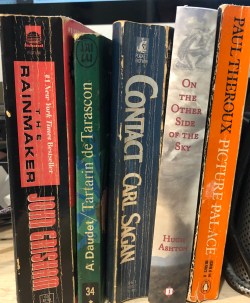
The photo is a mockup of the cover (printout of the design, and wrapped around a book of roughly the same thickness (just under 2.5cm, with 380 pages). In fact, I’ve slightly changed the spine from the photo above, so that it stands out a bit better:

The other books are there just to provide a comparison of size and of other designs. The back blurb is basically there – I don’t see it changing very much:

And the print and ebook editions will be available on the same day – December 1, 2021.

Price for the ebook will be £4.99 and Amazon US has it at $6.82 for pre-order. The US Amazon has some more information about the book and its writing than the UK site. The paperback will be available for pre-order soon.

There’s also a very new Facebook page about this book, where I will be writing bits and pieces about the content.