I’ve just received a list of the nominees for an award. The blurb below is for one of these, and it’s written by an established author, and published by an established firm. On Amazon, it has over 4,000 ratings, averaging four stars. This is clearly a book that people enjoy, but with this blurb, I don’t really understand why people are interested in it (names redacted).
A****, F****, E*****, and S**** are still young — but life is catching up with them. They desire each other, they delude each other, they get together, they break apart. They have sex, they worry about sex, they worry about their friendships and the world they live in. Are they standing in the last lighted room before the darkness, bearing witness to something? Will they find a way to believe in a beautiful world?
OK, so young people are aware of time passing. And they have sex and worry about it. And yes, young people are not perfect, and their relationships (sexual and other) ebb and flow. And they worry about all these things.
Why should I wish to read about these people? What makes them interesting or different? Is this the aim of this pedestrian blurb? To make me want to see why 4,000 Amazon readers think this is such a good book? I’m sure that a better blurb would sell more copies.
“Standing in the last lighted room before the darkness” – it’s a beautiful phrase, and one that many people will relate to. I think many generations feel that they’re the last hope of humanity, whether it be battling the evil Hun in the Great War, or the Nazis in the continuation of that conflict, or marching and protesting with CND about nuclear weapons, or even superglueing themselves to the M25 to raise awareness of climate change. So why are these four young people different? I’m not interested.
A book’s blurb blurb needs to show us why this book is so different from so many other books on the market (Amazon carries over 10,000,000 titles). This prose above just makes my heart sink, and excites me as much as a half-finished bowl of cornflakes.
I uploaded the EPUB version of On the Other Side of the Sky to the Amazon Kindle convertor and all seemed to be OK. No error message, EPUB looked great on my Kobo. I don’t own a Kindle and none of the pieces of emulation software seem to do their job on my computer.
However, when I could finally see the preview on screen following the release of the book (KDP offers an on-screen preview, but never seems to allow you to see the results of your latest upload, taking you straight to the pricing page once you’ve uploaded the new version) – all my fancy fonts had been stripped out (with no warning – thank you, Amazon) and so the nice little squiggly doodles that I’d carefully inserted came out as M and u.
In addition, it seemed that the InDesign TOC creation process had fouled up, putting Part headers at the end of the preceding chapter. Even going into the source code with Calibre, and cutting and pasting (and editing TOC files and the CSS files) didn’t seem to fix it.
So… start again with Vellum. A pain, but it works. Export from InDesign to RTF, open in Word, save as DOCX and import into Vellum, tidying up all the chapter and section divisions as I go. So as of today (December 1) the new edition is with Amazon having passed the initial checks. With luck you’ll be able to get it tomorrow. Same with Smashwords (Kobo, Apple, B&N, etc.).
On the Other Side of the Sky
A novel combining history, adventure, and more than a little touch of the arcane
I don’t mean “how many pages?”, but “how tall and wide should a book be?”. One problem that I’ve seen with a lot of books recently, especially self-published books, is that they’re too big to fit comfortably into a pocket or a bag.
Sometimes, this seems to be done in order to reduce the number of pages in a book, and therefore bring down the cost (the people who do this are probably the ones who use as small a typeface as possible in order to save space, and who also take the print right to the edge of the paper).
The printers I use for my books, Ingram Spark, happily have a wide range of trim sizes (the technical term for the page size of a book. Not every kind of paper is available in every size (there’s a choice between white, creme, and now something called “groundwood” which I’ve used for my latest, which has come out really nicely, and most of these sizes are paperback only, a few with hard covers and dust jackets. KDP, Amazon’s self-publishing service, offers a subset of these trim sizes.
Now, the cost to me of a hard cover is twice that of a paperback, even before I’ve paid the setup costs, and by the time I’ve factored in the very hefty discount that retailers demand, there’s really no incentive other than vanity for producing a hardcover for adult titles (but see below with regard to children’s books).
However, since I can choose the trim size, I’ve avoided the almost ubiquitous 6″ x 9″ and 5″ x 8″ options (sorry, since Ingram is an American company, they work in antique units for the most part) format which seems to be common to many books. I also, for the most part, tend to avoid the DIN A series of paper formats (1:1.41 ratio) which are OK for paper sheets, but don’t, IMHO, work for books.
When I started to produce On the Other Side of the Sky (at the top of this page) I decided to make it as close as possible to a “standard” or “classic” paperback size, whatever that might be. So I carefully measured up a Penguin, and designed around that. One thing about Ingram Spark is that they ask for a margin of 36pt (3p or 0.5″) on each side of the text block, so if you make your trim size small, remember to knock 72pt (6p or 1″) off each dimension for the text block.
Even so there are two of my titles where I felt that it was a good idea to make a minibook: Unknown Quantities, and my two Untime stories bound together in one volume:
And the reaction has been really positive. The people who have seen and handled the two above seem to love the small size – “a book you can take with you”. And for On the Other Side of the Sky, those who have seen advance copies have said about the paperback that it is a “real book, isn’t it? I can read it in bed”. Perhaps slightly insulting to an author who took many months to produce it, but flattering to the designer who took the words and set them in print. Very gratifying to have these decisions endorsed by readers.
But sometimes it’s a good idea to go slightly odd. For the hardcover of the anthology of our Sherlock Ferret series (hardcover comes into its own for children’s titles (the purchaser the reader is not always the reader and children’s books get a lot of wear and tear), I decided that a square page format would be eye-catching and practical, given Andy’s wonderful illustrations which need to be shown off to their best advantage, rather than being tucked away in a corner.
But it will feel better when they’re in the hands of readers and reviewers.
All ready for the gig on the 25th – if you’re in the Lichfield area and you are interested, take yourself off to the Erasmus Darwin site, and book your ticket now. Places are limited (COVID).
If you can’t make it, consider placing a pre-order on Amazon or even asking your local bookstore to order it (ISBN 9781912605750).
If you’re in Lichfield on November 25th, come along to Erasmus Darwin House at 6pm for a glass or two of mulled wine, a mince pie, and a good yarn.
For me, as the author, it’s incredibly exciting to be reading my fictional story in the real-life location where so many of the events in the book take place.
Jonathan Oates (“Jono”) will be hosting an event in which I shall be reading from and introducing On the Other Side of the Sky, my novel which blends local historical characters with fiction, and a splash of the paranormal.
On the Other Side of the Sky is coming together nicely. Currently going through it with the assistance of a friend, weeding out all the typos, and also minor details of plot and character which don’t seem to hang together very well.
A friend from the USA has suggested a glossary, to provide a little background information on people and topics that may be unfamiliar to some readers, so I’ve been busy with that.
I now have a design for the interior of the book, and several graphical elements, all of which are meant to evoke something of an 18th-century feel to the book, and which I should be able toinclude in the ebook as well. It’s going to be a very pretty piece of work indeed (in my opinion).
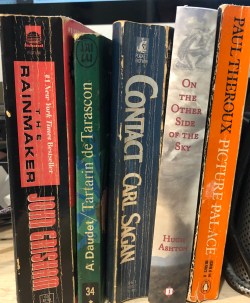
The photo is a mockup of the cover (printout of the design, and wrapped around a book of roughly the same thickness (just under 2.5cm, with 380 pages). In fact, I’ve slightly changed the spine from the photo above, so that it stands out a bit better:
The other books are there just to provide a comparison of size and of other designs. The back blurb is basically there – I don’t see it changing very much:
And the print and ebook editions will be available on the same day – December 1, 2021.
Price for the ebook will be £4.99 and Amazon US has it at $6.82 for pre-order. The US Amazon has some more information about the book and its writing than the UK site. The paperback will be available for pre-order soon.
There’s also a very new Facebook page about this book, where I will be writing bits and pieces about the content.
It’s generally accepted that Isaac Newton was at least as interested in alchemy as he was in mathematics – indeed, he may well have regarded one as an extension of the other.
However, in my reading about alchemy, I have discovered that the making of gold and the philosopher’s stone were regarded by many of the more hermetic and serious alchemists as being metaphors for spiritual enlightenment. Newton was hardly unaware of the theological and spiritual sides of life.
My question is why he continued expensive and arduous experimentation in his laboratory at Trinity College, Cambridge – apparently purely physical alchemy, refining mercury to produce the “spiritual quicksilver” (known by a variety of other names) necessary to achieve the ultimate physical alchemical goals, when he was presumably aware that the crucibles, slow heating, distillations, etc. of the alchemists were regarded by many merely as symbols of one’s spiritual growth.
Was this a compulsion to see, touch, test and record (the horrendous account of his poking a needle into his eye comes to mind)? Or was this an obsession with gold and money, which came to the fore in his offices at the Mint?
Can someone who knows more about Sir Isaac than I do please shed some light on this?
I’m coming to the end of The Other Side of the Sky (at least the first draft), and it’s proving to be a voyage of discovery for me. I’m 90,000 words into the story and there are probably another 10,000 to go.
There’s a lot of mysticism in parts of this book – of the 18th century kind. I have been reading a lot of alchemical texts, and have been surprised by what I have discovered. I had, like many of us, I suppose, always considered alchemy to be concerned with turning base metals into gold, and perhaps discovering the Philosopher’s Stone (the picture is by Joseph Wright of Derby, who appears as a character in my book, and is a detail of his painting of an alchemist, sometimes known as The Alchemist Discovering Phosphorus or The Alchemist in Search of the Philosopher’s Stone), which would grant eternal life or something to its possessor. Instead, I’ve discovered a mass of rich analogies, many of them confusing, if not outright contradictory, and all of them obscure, referring to a path towards spiritual perfection.
It’s impossible to separate these aims, and much of the imagery, from the Rosicrucians, who likewise expressed their secret doctrines in striking and colourful imagery. and from there, I suppose I could carry forward to the best-known 18th-century secret society, the Freemasons. However, I’ve decided not to go there.
Instead, I’ve chosen to go backwards, to an even earlier source of mystical spiritual growth, Kabbalah, a Jewish mystical tradition. Now, Kabbalah is far from being a simple subject. It speaks in analogies, and has many forms, but the underlying concepts are those of alchemy and Rosicrucianism, as far as I can make out. So I’m not speaking as an expert but as an outsider looking into a new world.
The Sefirot
This is a part of Kabbalah which has really attracted my attention, the Sefirot (there are many alternative transliterations), the ten energies (actually, there’s an eleventh “shadow” energy at the intersection of Keter, Binah and Chokhmah).
By moving from the source at Keter to Malkhut, one attains a realisation. It’s also possible to travel upwards, it seems, through to a union with the divine.
The links between these energies are typically associated with a letter in the Hebrew alphabet, and even with cards of the Major Arcana in the Tarot pack (this is a retroactive association, and was never made by Kabbalists, it appears).
But it also seems possible to link the Sefirot in other ways – paths which are in some way considered diabolical by many.
Here’s another view of the Sefirot which includes the letters associated with the links between the energies, and also includes Da’at, the intersection of Bina and Chockmah.
This diagram is sometimes referred to as the “Tree of Life” and is the subject of a lot of commentary and discussion. Even though there is a fair amount of low-hanging fruit that can be gathered from this tree by the non-adept, it would be possible, I am sure, to spend years studying it, with all the associations that have been made (many of them probably spurious or irrelevant). I’ve just come across a wonderfully paranoid conspiracy theory version which includes the Templars (of course), Akenahten, Freemansons, Jesuits, and puts the USA in the place of Malkhut!
As well as all of this, there is a rich corpus of Jewish legends, many of which have a bearing on this aspect of Kabbalah. One I have just been reading tells of the letters of the (Hebrew) alphabet all clamouring to God that they be allowed to be first in the alphabet. The one which ends up being the first (Aleph) is the one which did not shout for a place. Maybe Jesus was aware of this story when he said “The first shall be last, and the last shall be first”.
Bringing this up to date
There are many more modern interpretations that can be made here. I mentioned that conspiracy theory just now, but there are other ways of viewing these subjects, and it’s also possible to trace the gradation from alchemy to chemistry.
It’s also possible (and it has been done several times) to place a psychoanalytic interpretation on both alchemy and Kabbalah. Carl Jung, in particular, was particularly fascinated by both as windows into archetypes and into the collective unconscious. Whether or not you believe in the more mystical elements of Jungian thought, there is much to consider.
All in all, I’ve gone on an interesting journey with this research. While I cannot accept all the elements of the alchemists of Kabbalists, I have discovered more than just plot elements – and the existence and details of aspects of Jewish mysticism have been a real eye-opener to me.
I’ve been looking for some time at the reMarkable tablet – a sort of note-taking device. However, there are two or three things about it which did not attract me to it, despite the rave reviews and the attractive appearance of the thing.
It’s basically a one-trick pony – you can write and sketch on it – and to a certain extent you can read ebooks on it, but it’s not an ebook reader
The synchronisation between gadget and computer seems to be rather clumsy
Price: this is not a cheap option
I’ve owned a Kobo of one kind or another for some time now (I think this that I’m describing here is my fourth – the first broke about 10 years ago and was replaced free of charge by Rakuten, and then I bought another one five years ago for my wife so she could download books in Japanese here in the UK, but she didn’t like it, so I took it over to replace my aged one whose non-replaceable battery was dying.
So when Kobo introduced a larger ebook reader with the ability to accept handwriting and diagrams, etc., as well as the ability to read and mark up PDFs, I decided to splash out. The cost (£350) includes pen and smart cover, which is considerably less than the reMarkable’s price.
What you get in the box
The stylus is proprietary – you can’t use anything else. Happily, the stylus, which uses an AAAA battery (first time I’ve ever heard of such a thing) is nicely made, and the cover comes with a clip to hold it firmly. It’s pressure-sensitive, and you can use it as a brush, ballpoint, fountain, or calligraphic pen, with five (not fifty) shades of grey. There is also a highlighter and erase button on the barrel of the stylus.
And, when you come to use handwriting in the advanced notebook, you can convert handwriting to text with a double-tap of your finger.
Even works with diagrams and equations:
Far from perfect, but ok for a few seconds’ work.
Export over USB or Dropbox as an image, HTML, or Word docx.
And for PDFs, it’s great. You can’t type comments, but you can scribble and handwrite (no conversion there as yet, but I expect it to come). Sync via a dedicated Dropbox folder. I’ve used this for proofing and editing already. It’s one of the reasons I bought this thing, and I’m happy that it does what it says on the tin, very effectively. Sync over USB or WiFi through Dropbox.
There’s a link to Pocket, which allows you to read longer Web articles offline. I’ve used that quite a bit already (there is also a very rudimentary Web browser, which I haven’t used. Also a few games, which I’ve looked at.
The thing goes to sleep after a time or when you put the cover on, and you can add a PIN to prevent others from looking at your work – I intend using this for meeting agendas and so on, as well as editing other people’s work, so even this elementary security is useful.
As an ebook reader, it’s great. The size of the page allows a decent amount of text per page, at a reasonable size for reading (as with all Kobos, you can load your own fonts via USB connection. And you can scribble over the page, drag to make a highlight from which you can add a note – and you can browse through all your annotations, listed with a preview. It’s about as heavy and bulky as a thin hardback book. You can read in bed with it, or sit in a chair and read comfortably. Built-in light, and a dark mode, which makes the text white on black. Haven’t used that yet. Press and hold a word for a dictionary definition.
WiFi is fast and reliable in my experience. Syncing is sometimes done for you, as when an edited PDF is closed, sending the edited file to Dropbox, where it can be read, with annotations, on a computer. There were a few freezes when I first got the thing, but there’s been a software update since I bought it, and I expect there to be more, adding features that I think are missing right now. Purchasing off the Kobo store, and moving books to and from the cloud (either Kobo, or Dropbox for non-Kobo ebooks is simple).
Well worth the experiment, IMHO. Already it’s been used for real live work and will continue to be used.
Oh, and one more thing. I’m not enriching Jeff Bezos with this thing.
Add questions as comments, and I’ll do my best to answer them.
I can’t remember when I last read a book that I devoured so avidly – especially a book that’s not a genre thriller or whodunit (at least not in the classical sense). Borrowed from the library, started and finished in the space of a few hours.
It’s a book that mystifies, explains, uplifts and depresses, all at the same time. Told through the eyes of someone who is clearly not in the same world (physically and mentally) as the rest of humanity, it’s obvious that there is something very strange happening.
As “Piranesi” (not his real name) finds out more about his reality, we readers realise that what appeared to be errors in the continuity and credibility of the narration are in fact clues to the situation which we should have picked up, but we are so caught up in the wonder of Piranesi’s world and of his mind that we don’t bother questioning them as deeply as we might.
Not the overpowering tour de force that was Strange and Norrell, but a masterpiece on a far more constrained and miniature scale.
Pastiches? Homages? Rip-offs? Or simply imitations (“the sincerest form of flattery” according to Oscar Wilde)? I’ve written quite a few of these, taking on the mantle of four authors in my time: Sir Arthur Conan Doyle (Sherlock Holmes), William Hope Hodgson (Carnacki the Ghost-Finder), G.K.Chesterton (Father Brown), and latterly E.F.Benson (Mapp and Lucia). All of these have been well-received.
In these stories, I have always tried to maintain the style of the original authors as far as possible. This is more than a matter of recycling stock phrases (“You know my methods, Watson”, “tarsome”, etc.). Each of these authors has an individual style, even though in many cases their periods of activity overlapped with each other – there is much more to this pastiche business than simply copying the mannerisms of a bygone age’s language.
“After the initial chalk circle and pentacle, strengthened with garlic, the Electric Pentacle was obviously the first line of my defences to be established, and I welcomed the glow from its wards once I had assembled it. I performed the the Second Sign of the Saaamaaa Ritual at each vertex, though if matters were as I suspected, and that the beings reportedly described in the lost Heptatrych of Laskaria were involved, the Ritual would have little or no effect. My faith lay in the Pentacle, along with the linen-wrapped bread placed in the ‘Points’ and the water placed in the ‘Vales’, and I determined to spend the night inside that, provided, that is, that there was no clear natural cause for any untoward event.
From my “Carnacki at Bunscombe Abbey”
However well I think I have done with the style, though, when I look back at examples of the originals, I find that I have invariably missed something – at least to my eyes. There is always some element of subtlety that I seem to miss out when writing my pastiches. Even so, the majority of readers seem to think that I have captured the spirit of the originals. I like to think that no one could ever use Monet’s paintings of Rouen Cathedral as architectural blueprints, but they are unmistakably paintings of that particular building, in the same way that my writing is an impression of the writer whose work I am imitating. Incidentally, the hardest style of all to imitate has been Chesterton’s – he loves his little paradoxes and slices of religion to be slipped in. Very difficult to do.
“He is not a Catholic, then?” She sighed. “He is nothing,” she said. “That is to say, he claims that he cannot prove that God exists, or that He does not. Therefore, he mocks both those with faith, and those who deny faith. Though he is a most efficient and useful addition to the household, and of great assistance in Uncle Archie’s work, I – we – feared that my uncle would give him his notice if he were to continue in this fashion. It upset my uncle considerably.” “And yet you tell me that you love him?” asked Father Brown kindly. “I do. I have faith – faith that I can bring him to belief and into the bosom of the Church. I pray every night for him to believe.” This interesting conversation (interesting, that is, to the young lady at least, since Father Brown had heard that story, or one very similar to it, many times in his time as a priest) was interrupted by the entry of the young man in question.
From my “The Persian Dagger”
Characters are another matter. How far does one take liberties with the character? I like to think (and many critics have agreed with me) that my Holmes and Watson expand on the originals without changing their basic characteristics. I am not, for instance, going to make Holmes and Watson jump into bed with each other, but at the same time, I feel free to make more of the genuine affection that they feel for each other. The same applies to Mapp and Lucia and the inhabitants of Tilling. The characters are loved because of who they are, and any fundamental change to them would make them different people. They may grow and develop, but any outright change to their personalities would turn them into different people. I loved writing Mrs Weston in Riseholme – her streams of consciousness are a delight to write:
“Well, I really don’t know,” she said, after inspecting Georgie’s pieces of glass and invited to guess where he had found them. “I do declare that is just like the handle of a jug that Mr Weston used to have, which he inherited from his aunt, the one who used to live in Hastings and who married the man who invented a new kind of safety-valve to go on railway engines, and which he broke one afternoon after he came in from playing golf with the Vicar. I remember that he went round in 83 strokes, and the Vicar went round in 82, but he said the Vicar had cheated by moving his ball out of a bunker when he thought no one was looking.” She inspected Georgie’s treasure trove a little more closely. “I was just talking about this last week with Colonel Boucher when he was coming out of Rush’s and he had ordered half a pound of currants because Rush said he had no raisins, and why he had no raisins I couldn’t say if you begged me to tell you because he had some two weeks ago and Cook made a very nice pudding out of them. I couldn’t eat it all, and Cook and Elizabeth said they were the best raisins they had ever eaten in a pudding. And the Colonel said he had played golf and lost by one stroke and that put me in mind of that day and it was also the day the German Emperor made a speech about something which annoyed the Prime Minister and that was the very same day that Mr Weston broke the jug.” She paused for breath. “And how you ever got hold of that handle I don’t know, because I remember giving it to Elizabeth to throw away. ‘Wrap it up well,’ I said to her, ‘because someone might cut their hand on it and die of blood-poisoning like old Mr Marlowe who cut his thumb when he was raking the flowerbed in his front garden and he got blood-poisoning and died two– no, three weeks later, and then we’d get the blame.’ So what she did with it, I couldn’t tell you, but I haven’t seen it from that day to this when you showed it to me just now and I really have no idea where you might have found it.”
From my “La Lucia”
And then there are plots and settings. When you are writing a pastiche, you are writing for fans of the originals. If I slip up and put Mr Twistevant behind the counter of the fish-shop, or have Holmes and Watson take the London Underground Victoria Line, I would be rightly laughed out of court. Research and reference to the originals for facts and settings. And plots cannot be too outrageous (though in all the instances I have mentioned, the plots are pretty outrageous to start with) – they must be in scale with the settings of the piece. It is not impossible that the Prince of Wales, for example, sits on Mallards doorstep and smokes a cigarette. It is, however, most unlikely that he would ring dear Liblib’s belly-pelly and ask to be invited in for a cup of tea.
So, the brief answer to “how do I write pastiches” is, “I write stories that the original author didn’t have time to write”. I like to think that Sir Arthur Conan Doyle might well have written:
As a doctor, I am sworn to protect the life of others. As a human being, I am obviously anxious to protect my own life. And as a friend of Sherlock Holmes, I was never more determined to protect his well-being than at that moment. I fired my revolver, and the wretch dropped his weapon, clutching at his arm with a sharp cry.
We use cookies on our website to give you the most relevant experience by remembering your preferences and repeat visits. By clicking “Accept”, you consent to the use of ALL the cookies.
This website uses cookies to improve your experience while you navigate through the website. Out of these, the cookies that are categorized as necessary are stored on your browser as they are essential for the working of basic functionalities of the website. We also use third-party cookies that help us analyze and understand how you use this website. These cookies will be stored in your browser only with your consent. You also have the option to opt-out of these cookies. But opting out of some of these cookies may affect your browsing experience.
Necessary cookies are absolutely essential for the website to function properly. These cookies ensure basic functionalities and security features of the website, anonymously.
Cookie
Duration
Description
cookielawinfo-checkbox-analytics
11 months
This cookie is set by GDPR Cookie Consent plugin. The cookie is used to store the user consent for the cookies in the category "Analytics".
cookielawinfo-checkbox-functional
11 months
The cookie is set by GDPR cookie consent to record the user consent for the cookies in the category "Functional".
cookielawinfo-checkbox-necessary
11 months
This cookie is set by GDPR Cookie Consent plugin. The cookies is used to store the user consent for the cookies in the category "Necessary".
cookielawinfo-checkbox-others
11 months
This cookie is set by GDPR Cookie Consent plugin. The cookie is used to store the user consent for the cookies in the category "Other.
cookielawinfo-checkbox-performance
11 months
This cookie is set by GDPR Cookie Consent plugin. The cookie is used to store the user consent for the cookies in the category "Performance".
viewed_cookie_policy
11 months
The cookie is set by the GDPR Cookie Consent plugin and is used to store whether or not user has consented to the use of cookies. It does not store any personal data.
Functional cookies help to perform certain functionalities like sharing the content of the website on social media platforms, collect feedbacks, and other third-party features.
Performance cookies are used to understand and analyze the key performance indexes of the website which helps in delivering a better user experience for the visitors.
Analytical cookies are used to understand how visitors interact with the website. These cookies help provide information on metrics the number of visitors, bounce rate, traffic source, etc.
Advertisement cookies are used to provide visitors with relevant ads and marketing campaigns. These cookies track visitors across websites and collect information to provide customized ads.